




LIVE7hrs ago
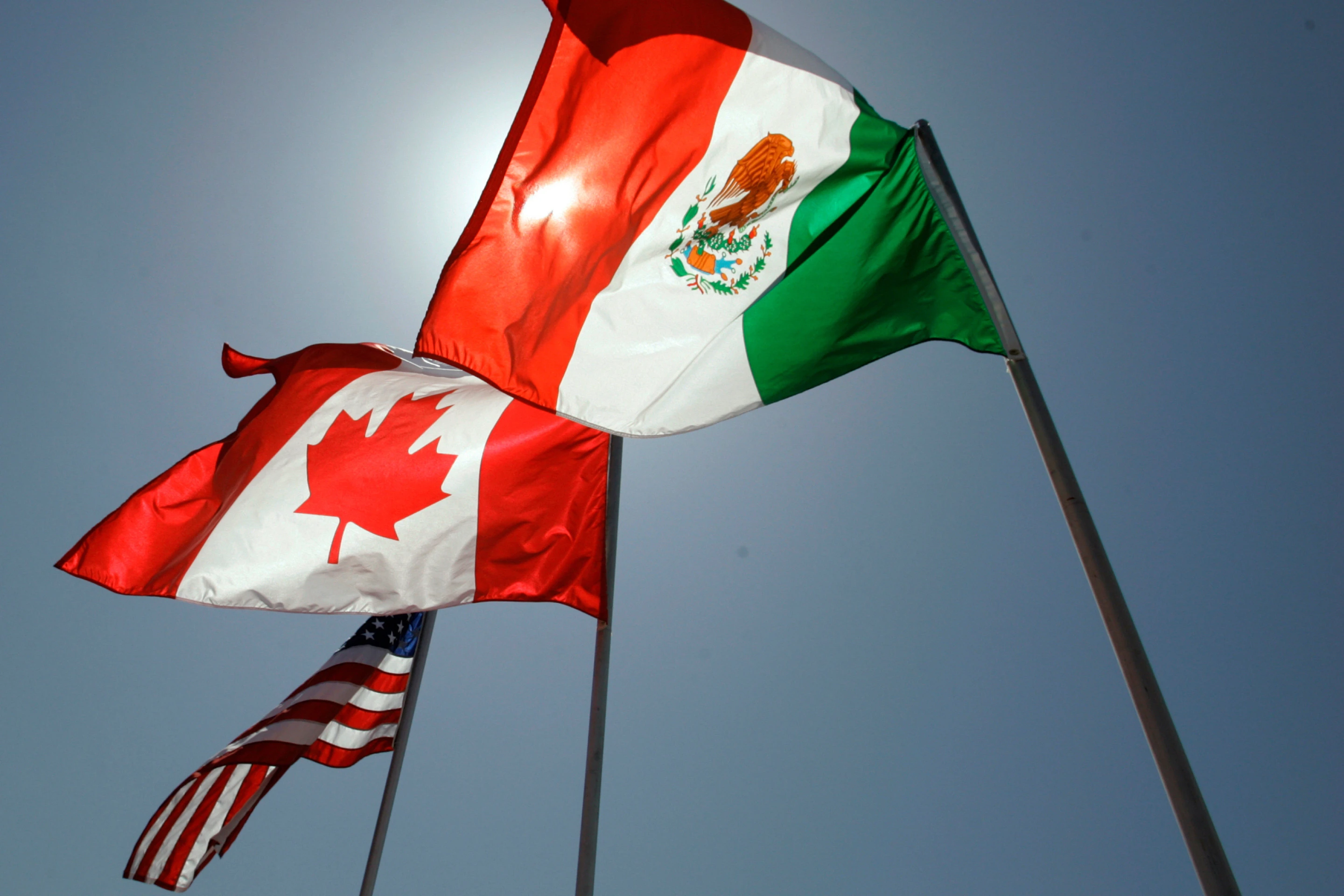
National flags representing the United States, Canada, and Mexico fly in the breeze in New Orleans where leaders of the North American Free Trade Agreement met on April 21, 2008.



WASHINGTON — Tourists from Chattanooga check in to beach resorts in Cancun. Canada’s car parts feed factories in the American Midwest and vice versa. Partiers are toasting with glasses of Mexican tequila and mezcal in Seattle pubs.
Makes sense. Canada and Mexico, the U.S. does $1.9 trillion a year, or $5 billion a day, worth of trade in products and services with its neighbors. They have surpassed China as America’s top two trading partners.
So there are enormous stakes in tampering with the regulations governing trade between the three countries. And after a year of President Donald Trump’s turbulent tariff policies many U.S., Canadian and Mexican firms would welcome a return to normalcy across North America.
They aren’t going to get it.
Trump’s regional trade deal, the U.S.-Mexico-Canada Agreement, or USMCA, which he negotiated and bragged about, came up for renewal Wednesday, launching a process that will likely take months, maybe longer.
And the road ahead is full of landmines.
“There is going to be a lot of drama this summer,” Diego Marroquín Bitar, a fellow in the America’s program at the Center for Strategic and International Studies, told a forum last week on the USMCA sponsored by the Cato Institute.
The U.S. is seeking changes that could require Canada and Mexico to give over some automaking to the United States. That might mean more auto production jobs in the U.S. But it also would upend established supply chains and would push up U.S. costs for new automobiles that presently average over $50,000 at a time when American customers already are upset about the high cost of living.
Trump, as usual, has made the tensions worse by threatening to abandon his own deal totally.
The North American Free Trade Agreement of 1994 was replaced by the USMCA in 2020, which eliminated most tariffs between the three North American countries.
Trump and other critics said NAFTA killed jobs by encouraging U.S. corporations to shift manufacturing south of the border to take advantage of low-wage Mexican workers and then send goods back to the U.S. tariff free.
His USMCA ended up looking like NAFTA but it forced manufacturers to pay higher wages and to ensure more of what they created came from North America in a move to keep Chinese items from crossing regional borders tax free.
To renew or not renew? The USMCA added a new provision requiring the accord to be renewed every six years. The deadline was Wednesday.
The three countries met electronically Wednesday, but U.S. Trade Representative Jamieson Greer said in a statement that the United States was not ready to renew the treaty as it stands for another 16 years — which would have been until 2042. The U.S. seeks modifications to the deal to narrow trade deficits with Canada and Mexico and settle particular problems, including Canada’s protection of its dairy industry.
The USMCA is still in place while the three countries try to find a solution to work out their differences and they have until the present term runs out in 2036 to strike a deal. Or else the deal expires.
Mexican Economy Secretary Marcelo Ebrard said in a video uploaded on his social media accounts he was “confident that the review of the treaty can be completed within a reasonable time frame.”
“We are not in a hurry, but we also don’t want there to be any uncertainty, which is why we need to try to reach an agreement on many issues,” he said. “We try to have fewer open issues each year in that review.
Any of the three USMCA countries can walk out of the deal, but they have to give six months notice to its two partners. It’s a red buzzer for Canada and Mexico, who depend on trade with the United States, and fear Trump may just hit it.
Trump, after all, indicated in June he was “not looking to renew” the trade accord with Canada and Mexico. "We don't need anything they got," he replied.
The United States and Mexico are discussing renewing the trade pact. But so far Canada has been left out of the picture.
“Here’s what we’ve agreed to. The danger for Canada is this: that the U.S. government and the Mexican government reach agreement on changes to core provisions of the treaty and then show up in Ottawa and say, ‘ It’s all or nothing.
“I’m not looking for my pen,” Canadian Prime Minister Mark Carney said, adding the three trading partners plan to meet digitally Wednesday.
Carney then said in French that his aim is to update the USMCA and that it is difficult for the U.S. to have a new agreement without the assent of Congress.
The U.S. wants a revised trade treaty to do more to make sure Chinese goods don’t come in the back door. The most contentious issue, however, is a U.S. drive to compel more items to be created in North America — and the United States specifically.
The USMCA increased the percentage of the value of automobile items that must be made in North America to qualify for duty-free treatment to 75% from 62.5% under NAFTA.
The US wants to increase the 75% barrier even higher but that won’t be easy. “Automakers have been optimizing their supply chains for years to reach that 75% mark,” said Childress. They would require time to reach the higher standard.
Carney stated in early June that the U.S. is also pushing for a brand new requirement: that cars be built in the United States half of the time. None of the USMCA countries have a guaranteed output share right now. “It is a red line for Mexico and Canada and it is against the spirit and the letter of regional integration,” said Oscar Ocampo, director of economic development at the Mexican Institute for Competitiveness.
Marcos Carias, an economist at the credit insurer Coface, said only 1 in 5 Mexican and Canadian autos shipped to the United States would now fulfill the 50% criteria.
Vehicles anticipated to see higher pricing under the plan include Ford’s Maverick compact pickup truck, Chevrolet’s mid-size Equinox SUV and select Nissan cars – all built in Mexico. Carias’ “back of the envelope” assessments imply costs could rise 5% to 7% on the most-affected models.
Businesses desire certainty Many companies simply want to get rid of Trump’s ever-changing tariffs. “My interest in this USMCA renewal is just consistency, right?” said Shawn Miller, co-founder of PKGD Group, which imports agave spirits (tequila, mezcal and raicilla) from family producers in Mexico. If the rules change, the rules change. But we’d really like to know (what they’re going to be) and we’d like them to stay that way for a while.”
PKGD is having a great run. Sales at the Holland, Mich., company are up 62% this year, after climbing 100% in 2025 and 300% in 2024.
But last year was a mess.
In February, Trump imposed a 25% import tariff on Mexican and Canadian goods, only to reverse course a month later and exempt products eligible for special USMCA treatment. Under the USMCA, Mexican spirits may enter the United States on a duty-free basis.
In the midst of the chaos, three truckloads of Mexican spirits imported by PKGD crossed the border into the United States and were slapped with the 25% levy. The price was $105,000. “Just one bad day for us!” Miller stated.
PKGD met with its Mexican producers to work out how to respond, unsure what tariffs Trump would dream up next. “‘What can we take on? “What can they soak up?” Miller said. "How do we mitigate this?"
“I don’t want to be a multinational conglomerate with a bunch of lawyers and lobbyists writing trade policy,” Miller added.
Kerry Mellin knows how that feels.
The experienced Hollywood costume designer founded a firm in Ventura County, California, in 2014 selling silicone grips allowing people with disabilities (including cerebral palsy and Parkinson’s) to handle objects – spoons, cups, pens, toothbrushes.
But sales faltered when she launched her EazyHold grips in Canada, where she holds dual citizenship. She says that’s because the silicone she imports from Asia stopped her grips from having enough North American content to qualify for USMCA’s duty-free status when crossing the border from the United States.
Mellin feels EazyHold could meet the USMCA standards, “but the rules are complex and unpredictable enough that I truly can’t be sure without hiring a trade attorney.”
Mellin says the rules of origin in the USMCA should be eased — not tightened — to benefit small businesses that can’t afford more expensive raw materials from North America.
“I understand why the rule is in place — to stop companies from sending Chinese goods through Mexico,” she added. “I just wish it could tell the difference between that and a little family business in California making grip aids for people who can’t hold a fork. "I'm not the problem they were trying to fix."

August 11, 2026

August 08, 2026
August 05, 2026
July 29, 2026

July 14, 2026