Friday, February 27, 2026







LIVE 2hrs ago
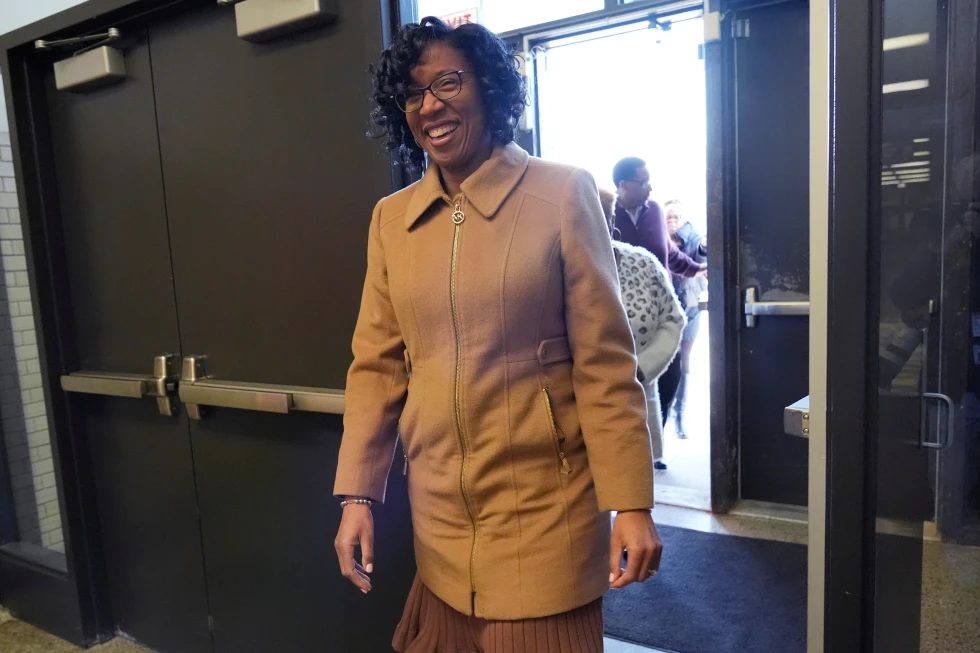
Chicago Treasurer Melissa Conyears-Ervin smiles as she walks into Marshall Metro high school to vote in Chicago, March 19, 2024.

WASHINGTON —The American Israel Public Affairs Committee, a strong advocacy group that is causing new controversy over the Democratic Party's ties to Israel and the role of undisclosed campaign funds in this year's midterm elections, is expected to face its next challenge during a packed primary season in Illinois.
In the battle to succeed retiring veteran Democrat Rep. Danny Davis, AIPAC, which was established decades ago to advocate for U.S. support for Israel, has set aside at least $1.9 million in advertising through its super PAC. The group wants to help Chicago city treasurer Melissa Conyears-Ervin defeat a dozen other contenders in the March 17 primary.
In Illinois, which is already notorious for its bare-knuckled politics, other groups that detractors say are connected to AIPAC are also making significant expenditures there, igniting resentment and accusations.
The extravagant expenditure follows AIPAC's over $2 million investment in a recent Democratic primary for a special election in New Jersey, which is generally regarded as a failure. Analilia Mejia, a progressive candidate who has been vocal in her condemnation of Israel, narrowly defeated former congressman Tom Malinowski, who was singled out by AIPAC.
Despite a barrage of condemnation from people of all political persuasions, AIPAC seems unfazed by the event.
Speaking on behalf of the United Democracy Project, or UDP, AIPAC's connected super PAC, Patrick Dorton stated, "We anticipate being involved in dozens of races both in primaries and general elections this cycle."
Since the conflict in Gaza has increased Democratic skepticism and even antagonism against the U.S.-Israel connection, putting typical bipartisan backing for military assistance to a longstanding friend in jeopardy, AIPAC has pursued its purpose more urgently. However, the group runs the risk of further dividing the party and undermining any lingering goodwill due to its aggressive interventions in this year's primaries, which are anticipated to grow in the upcoming months.
Super PACs and campaign finance regulations make it practically hard to identify the source of much of the money spent in Illinois. Even though UDP is transparent about its allegiance, newer organizations like Affordable Chicago and Elect Chicago Women have not yet been obliged to reveal where their funds come from.
Neither party must reveal its funding until after the Illinois primary. Opponents believe they are receiving funding from AIPAC, although the organization has refrained from confirming any link.
Affordable Chicago, UDP, and Elect Chicago Women With nearly $11 million spent on ads in House races thus far, Illinois has accounted for the majority of these expenditures, making them three of the top four spenders. AdImpact, a neutral ad-tracking service, provides the financial data.
AIPAC-affiliated groups have also employed this tactic in the past, but none of the organizations make reference to Israel in their campaign messaging.
For instance, Malinowski was attacked by the United Democracy Project in New Jersey for being in favor of President Donald Trump's deportation initiatives, which undermined him in the eyes of liberal voters. In Illinois, it is endorsing Conyears-Ervin to take Davis' seat in the 7th congressional district, claiming she will work to safeguard healthcare and cut expenses.
The tactic has added to anxiety and conjecture regarding AIPAC's political clout. The focus on AIPAC is inappropriate, according to some, while proponents of Israel accuse detractors of employing antisemitic clichés about dual loyalties.
"I believe the people who are discussing AIPAC the most are trying to discredit Israel and sever ties between the United States and Israel," said Rep. Brad Schneider, a Democrat from Illinois' 10th district.
According to Schneider, co-chair of the Congressional Jewish Caucus, "Citizens United and the decision to allow dark money are the problem." The regulations are the issue. Let's make the rules better.
Each candidate has been criticized by the others for allegedly accepting AIPAC's assistance. In February, four progressive candidates running for several congressional seats in Illinois jointly denounced the group's involvement in the state's primaries. On her website, another candidate is selling t-shirts with anti-AIPAC slogans.
Still reeling from his time as AIPAC's target in New Jersey, Malinowski declared he would not supporting any of the group's candidates this year. Despite his opposition to unconditional aid for Israel, which infuriated AIPAC, he identified as pro-Israel.
"It goes without saying that we would discuss Israel and Gaza during the campaign because a lot of voters would have questions about it," Malinowski stated. "However, I wanted those conversations to be about the content and not be tainted by the baggage of endorsements from now-controversial groups."
In a statement, AIPAC acknowledged that Mejia's primary victory was "an anticipated possibility," implying that they had no qualms about their involvement in helping to open the door for a candidate who has called Israel's conduct in Gaza "genocide."
Despite its long history of political activism, AIPAC started directly funding races in the 2022 midterm elections.
According to Federal Election Commission reports from December 2021 to January 2026, it has since spent over $221 million through both its super PAC and traditional PAC.
Democratic primaries have been the super PAC's primary emphasis. UDP invested at least $1 million between 2022 and 2024 to support or oppose 18 politicians, 16 of whom were Democrats. A large number of such candidates were competing in open contests.
Conventional PACs may work directly with campaigns and are permitted to raise and donate up to $5,000 per candidate per election. Super PACs are exempt from spending and fundraising restrictions, but they are not permitted to coordinate messages or provide candidates direct or in-kind contributions.
The UDP's largest expenditures in 2024 were toward backing moderate candidates against leftist incumbents. In the 2024 Democratic primary in New York's 16th District, where incumbent Rep. George Latimer defeated former Rep. Jamaal Bowman, it spent over $13 million. Additionally, it invested $8.5 million to defeat former Representative Cori Bush, who was defeated by Representative Wesley Bell in her primary.